

Refurbished electronics inventory software, costed device by device
Two identical devices are not the same stock. SlickCell is refurbished electronics inventory software for shops that buy, refurbish and sell used phones, tablets, laptops, games consoles and smartwatches: every device is its own record, by IMEI or serial, with its own cost, condition and price, and taxed under the UK VAT margin scheme where it applies.
Where second-hand stock stops adding up
Quantity-based stock control was designed for parts. Devices break it.
Four of the same model in stock, bought for four different prices, showing as one line.
A device sells and nobody can say which one went, or what it cost.
Which units came in on a tax invoice and which did not is in somebody's memory.
Battery health and condition were noted on the box, and the box is gone.
A device is sold at the shelf price when that particular unit cost far more.
A returned device goes straight back on the shelf without anyone checking it.
Three of the same laptop, each with a different battery and a different cost.
One used device, one record, from purchase to sale
A device unit is created when the device arrives and is closed when it leaves. Everything about it hangs off that one row.
- 01IntakeThe device gets its own record and its own reference.
- 02SpecsStorage, colour, condition, battery health and network, per unit.
- 03CostWhat this device cost you, not what the model usually costs.
- 04PriceA selling price on the unit itself, not on the model.
- 05SaleThat specific unit leaves stock, at its own price.
- 06TaxIf it sells on the margin, the tax follows the margin.
- 07AfterA return goes back on the shelf only when someone chooses it; otherwise it waits to be inspected.
Because quantity is derived from the units rather than typed, the count and the shelf cannot drift apart. There is no number for anyone to correct.
Refurbished stock with its own cost and condition
Not a stock line. A device.

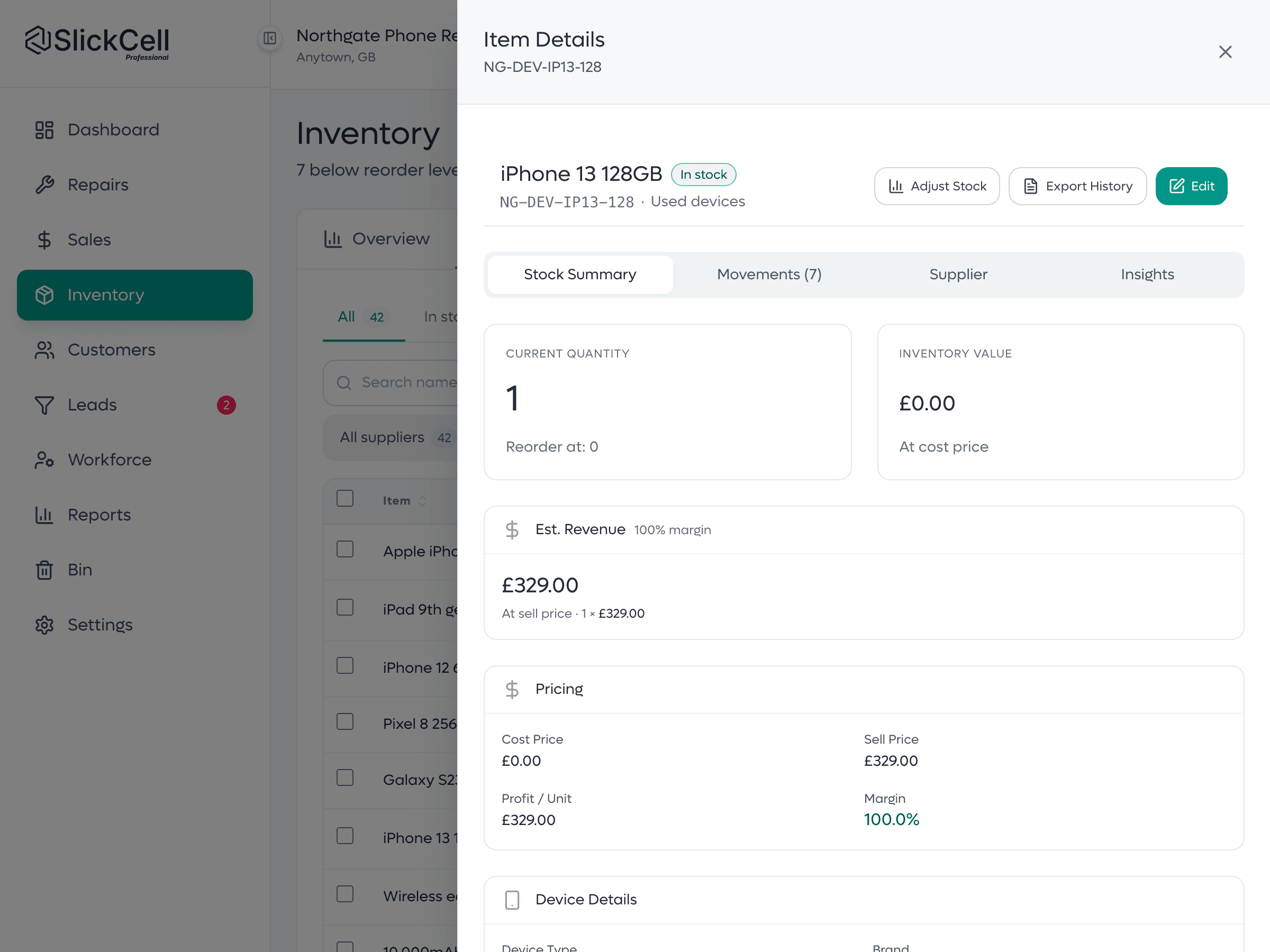
Where this device came from and what it did
Its reference, its specs, what it cost, what it sold for and every movement in between, for that unit, not for the model. When a customer comes back three months later, the answer is on the record.
Quantity is derived from units. Nobody types a stock number.

The unit's price wins, every time
A device that cost more sells for more, even if the model's default price says otherwise. The price is taken from the unit when the invoice is raised, so a busy counter cannot accidentally sell a premium unit at the shelf figure.
The unit's price is applied when the sale is written, not read off the model.
The VAT margin scheme on one used device, worked through
The same figures as our free calculator and the VAT margin scheme guide.
- Bought from a member of the public: £180.00
- No VAT was charged, so there is none to reclaim. The £180.00 is held on that unit as its cost.
- Sold for £240.00
- The price comes from the unit when the sale is written.
- Margin: £240.00 − £180.00 = £60.00
- VAT is due on the margin, not on the £240.00.
- VAT: £60.00 ÷ 6 = £10.00
- One sixth, because the margin already includes the VAT (20/120). Charging the standard rate on it would be £12.00.
- Kept after VAT: £50.00
- Without the scheme, VAT on the full £240.00 would have been £40.00.
- A £40.00 part fitted before sale: the VAT is still £10.00
- Repairs and parts cannot go into the margin. Where you were charged VAT on the part, you reclaim it on your VAT return in the normal way. What you keep is £50.00 minus £40.00: £10.00.Read the full guide to the VAT margin scheme
General information, not tax advice. Check HMRC's guidance or speak to your accountant about your circumstances.
Used and refurbished stock you can price and tax
- Real margin per device
- Profit is this unit's price minus this unit's cost: not an average across a model that flatters the good buys and hides the bad ones.
- Tax that follows the unit
- Margin-taxed stock is treated on its margin and reported separately from standard-rated sales.
- A history you can answer from
- Every unit carries where it came from, what was done to it and where it went.
- Returns that get a decision
- A refunded device comes back as a unit someone decides about, not as a number added to a count.
Every SlickCell feature is included on every plan: plans differ by team size, locations, discounts and support.
The ones that catch out quantity-based systems
- You only know the last four digits
- The reference is free text on purpose. Shops key shorthand, and a system that refuses it just gets a fake number typed into it instead.
- Two units end up with the same reference
- It is flagged as a conflict to resolve rather than blocked outright, so the unit still gets recorded, and the clash surfaces where someone can fix it.
- One model, six different costs
- Each unit holds its own. There is no average cost standing in for six different purchases.
- Some units came in on a tax invoice, some did not
- That is a property of the unit, which is what decides how its sale is taxed.
- A sold device comes back
- It returns to a state that means 'returned', not 'available'. Putting it back on the shelf is a decision someone makes, not a side effect.
- A unit is being held for a customer
- Reserved is its own state, so it is not sold twice while the customer thinks about it.
- The device is locked and the customer left the code
- PIN, password or a drawn pattern can be held against the device, behind a role check, and every look at it is recorded.
None of these need a workaround. They are states a unit already carries.
What unit tracking carries
One unit, one record
Every physical device is its own row, from intake to sale.
Free-text references
IMEI or serial as you actually write it, with clashes flagged rather than blocked.
Specs per device
Storage, colour, condition, battery health, network and region on the unit.
Cost and price per device
What this one cost and what this one sells for: the unit's price is the one that applies.
Margin tax where it applies
Used stock can be taxed on the margin and reported apart from standard sales.
Movement history
Every state change on the unit, with who did it and when.
Refurbished and used stock: what shops ask
If you are VAT registered, yes, but under the margin scheme only on your margin. Buy a used phone for £180.00, sell it for £240.00, and the VAT is one sixth of the £60.00 difference: £10.00. If the scheme's conditions are not met, VAT is due on the full selling price.
No. The reference is free text, so last-four or last-five shorthand is fine. That is how shops actually work. There is no format or checksum validation, deliberately: a system that rejects real-world shorthand only teaches people to type a fake number that passes.
The clash is detected and flagged for someone to resolve, rather than the unit being refused at the point of entry. The record still exists, and the conflict surfaces where it can be dealt with.
Yes. Tax is a rule you configure, and margin is one of the rule types, scoped to used stock. Each device carries its own purchase cost, so the margin on every sale is worked out from that unit, and margin-taxed sales are reported separately from standard-rated ones.
Not unless someone chooses it. At the refund you say where the device goes: back to stock as new or as used, to Faulty Items to be inspected first, or back to the supplier. By default it waits in Faulty Items.
No. Parts and accessories stay quantity-based, which is the right model for them. Unit tracking is for the stock where each item genuinely differs.
Bring five devices you bought for five different prices
We will put them in as units, price them, sell one, and show you what the margin and the tax actually did.