

Repair shop CRM for customers and their devices
The same person, the same device, the third time they come in. SlickCell keeps every repair, sale, payment and device against the customer who owns it, so the original job, the part that went in and whether it is still under warranty are on the record.
Where customer history goes
Almost every shop has this problem, and almost none of them call it a CRM problem.
A customer returns with the same fault and nobody can find the original job.
Their number is in one person's phone, under a nickname.
Two records for the same person, spelled differently.
Nobody can say whether the repair they are complaining about is still in warranty.
The device passcode was written on a sticky note that came off.
A refund was given months ago and there is no trace of why.
One person, everything attached
The customer record is not a contact card. It is the thing every job, sale and payment hangs off. Repair history, devices, quotes and invoices, messages and reviews hang off one customer.
- 01The personName and contact detail, captured once at the counter.
- 02Their devicesDevices linked to the person who actually owns them.
- 03Their jobsEvery repair against the customer and the device it was on.
- 04Their moneySales, payments, refunds and credit notes as one history.
- 05Their messagesWhat they were told about the job, and when.
- 06Their viewWhat they said about the work, from the link on the receipt.
Because the invoice freezes who the customer was when it was issued, correcting a name today does not quietly rewrite a document that was already given to someone.
The record the counter actually needs
Answering the question a returning customer just asked.

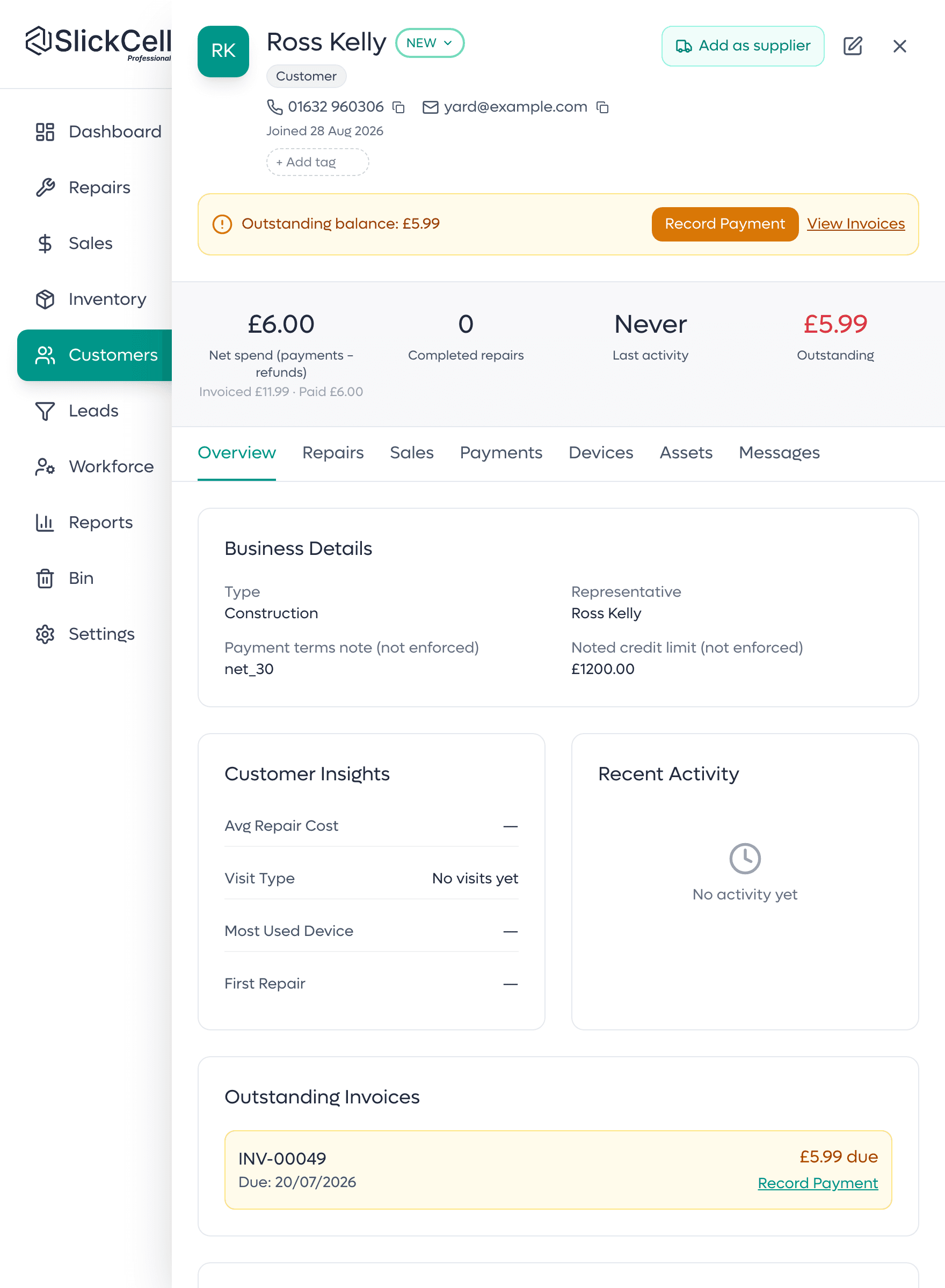
Which device, which job, and is it still covered
Devices belong to the person who owns them, and every repair sits against both. When someone comes back with the same fault, the original job, the part that went in and whether it is still in warranty are on the record, not reconstructed from a date and a guess.
Ownership transfers are recorded, so a resold device does not stay attached to the wrong person.
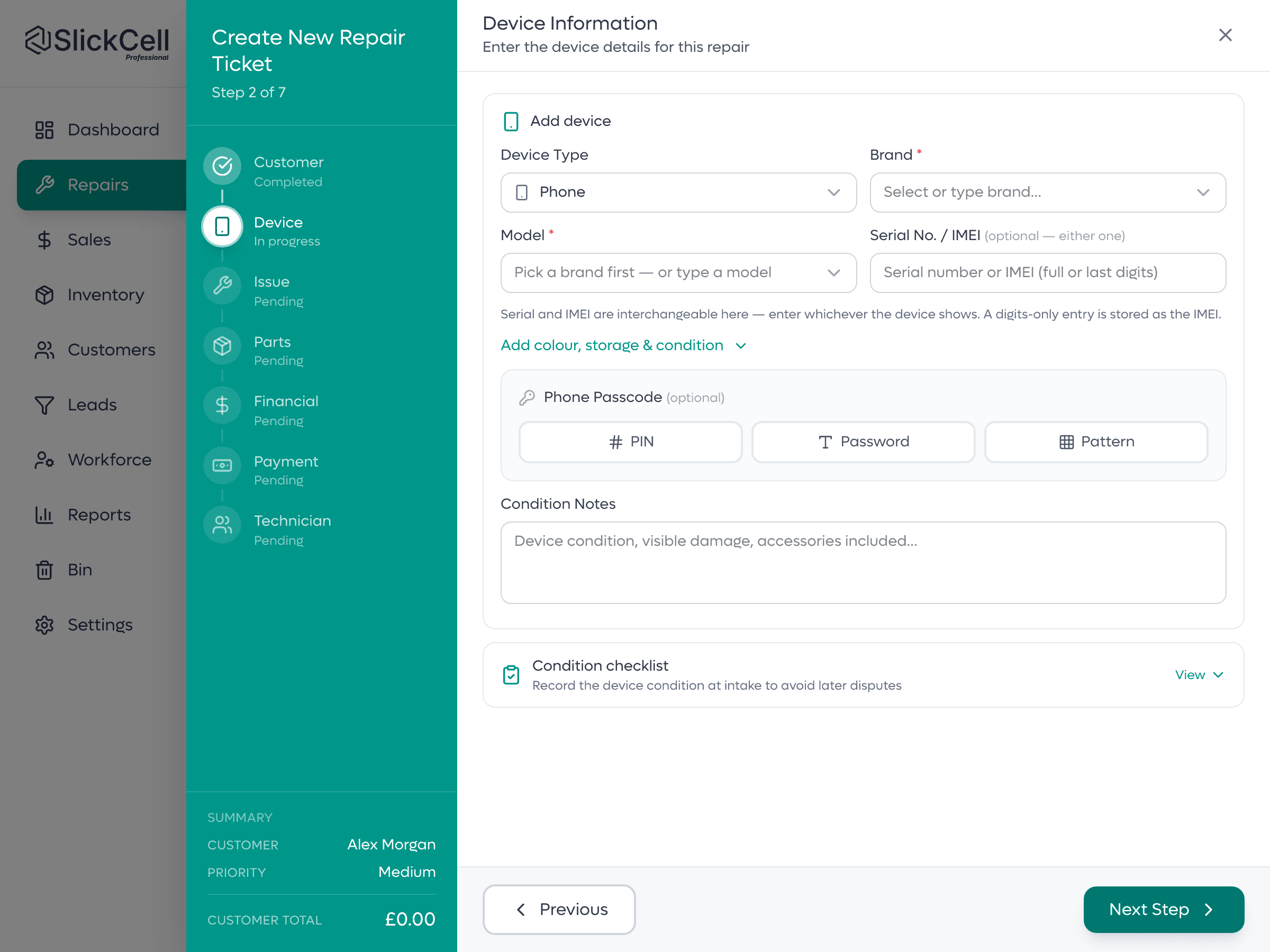
The passcode, held properly
A PIN, a password or a pattern drawn on a 3x3 grid: the three ways phones and tablets lock. It is stored behind a restricted call rather than sitting on the device record, ordinary screens never return it, and every time someone reveals it that is checked against their role and written to the audit log.
Every reveal of a passcode is role-checked and recorded.
Repeat customers stop starting from scratch
- Warranty questions have an answer
- The original job, the part and the cover are on the record, so the counter is not negotiating from memory.
- Devices belong to people
- Devices are linked to owners, and a change of owner is a recorded action.
- One financial history
- Sales, payments, refunds and credit notes read as one story rather than four lists.
- Codes are held safely
- Unlock codes are restricted and every look at one is audited.
Every SlickCell feature is included on every plan: plans differ by team size, locations, discounts and support.
The awkward ones, handled
- The same person entered twice
- Matching helps catch it at the counter, where it is cheap to fix, rather than at year end when it is not.
- They sold the device to someone else
- Ownership transfer is a recorded action, so the device moves to the new owner and the history of the move survives.
- Their name was spelled wrong on an invoice they already have
- Correct the customer, and the issued invoice keeps the identity it was issued with. A document someone is holding does not change under them.
- A credit note from a refund months ago
- It is refund history: a record of what was returned and why. It is not a spendable balance, and the page never pretends otherwise.
- They want to know how the repair is going
- The QR on their ticket opens a status page for that job, with no login and no account.
- You need to tell fifty customers something
- Messages can go to a group of customers on a template, and each one is kept against the customer it went to.
- The customer left a bad review
- It arrives against the job and the technician who did it, with the attribution fixed at the moment it landed.
Store credit from a trade-in is a different thing to a credit note: that lives with buyback.
Repair shop CRM software: what the customer record carries
The person
Contact detail captured once, with duplicates caught at the counter.
Devices they own
Devices linked to their owner, with transfers recorded.
Every job and sale
Repairs, purchases and warranty state against the person and the device.
One financial history
Payments, refunds and credit notes as a single story you can follow.
What they were told
Messages sent from the job, on a template, kept against the customer.
What they thought
Ratings from the link on their receipt, attributed to the job that earned them.
Questions about a repair shop CRM
Yes: a repair shop CRM, meaning the operational record a counter needs. Who owns which device, what you did to it and what they paid, ready the moment someone walks back in. Bulk messages go only to customers who have opted in to marketing, and only when you choose to send them.
By text or email from the job, on templates each shop can edit. Every receipt and repair label also carries a QR code that opens a live tracking page, with no app and no login.
Behind a restricted call, not on the device record. Ordinary screens never return the code, revealing it is checked against your role, and every reveal is written to the audit log. Patterns are supported as a drawn 3x3 sequence, because that is how a lot of phones and tablets lock.
No. Credit notes here are refund history: the record of what was returned and why. Spendable balances come from trade-ins, which are a separate ledger. We keep those two apart deliberately, because conflating them is how shops end up honouring the same money twice.
No. An invoice freezes the customer identity it was issued with. Correcting the record going forward does not rewrite a document somebody is already holding.
Yes. The link on their receipt lets the customer rate the job, and the rating lands against that job and the technician who did it, with the attribution fixed at the moment it arrives. Staff can read reviews but cannot edit them.
Bring a customer who has been in three times
We will build the record, attach the devices and the jobs, and show you what the counter sees on the fourth visit.