

Game console repair software that tracks every console by serial
SlickCell is game console repair software that books every console in by its serial number, sells refurbished consoles as their own units and takes trade-ins on the same system.
One console, from the counter to the shelf
SlickCell is built for UK shops that fix and sell PlayStation, Xbox and Nintendo consoles alongside phones, tablets and laptops. A games console is its own device type in SlickCell, with more than 250 console models to pick from, handheld gaming PCs such as Steam Deck included, and its own fields on every console you stock or buy in: storage, edition (disc or digital) and controllers included. It is identified by its serial number. At booking there is one field for "Serial No. / IMEI", and a serial with letters in it is saved as a serial number, not squeezed into an IMEI. The job moves through quote, awaiting parts and repaired on one ticket, and the ticket is assigned to the technician doing the work. When you refurbish a console to sell, it goes into stock as its own unit with its own serial, cost and price, and the till finds it when you type or scan that serial.
Monday morning a Nintendo Switch 2 comes in running hot and loud: it needs a fan clean and fresh thermal paste. It is booked in as device type Games Console, and the brand and model lists offer console makers and console models only. The serial is typed as printed on the sticker under the stand. It starts with letters, so it is saved as a serial number and the ticket shows it as S/N.
The work is quoted before it starts, and nothing moves until the customer approves. The ticket is assigned to a technician, the paste and any part used come off stock onto the job, and the balance settles at collection against any deposit taken at booking.
Later that week a customer trades in a PlayStation 5 Digital Edition. It is inspected and bought on a buyback record with device type Games Console, its serial in the free-text IMEI / Serial field, and the edition and the controllers included recorded with it. The seller is paid in cash, by bank transfer or as trade-in credit against a sale. Added to inventory, it becomes a stock unit at what it cost you, the price paid plus any refurbishment, and it sells at the till when someone types or scans its serial.
The modules that made it happen
RepairsInventory & device unitsTrade-ins & buybackPoint of sale
Booked, repaired, refurbished and sold by serial number
HDMI port replacements, disc drive replacements, fan cleans with fresh thermal paste and controllers with stick drift: each job passes through the same states, on the ticket and in the queue.
- 01Booked in by serialDevice type Games Console, brand, model (disc and digital are separate models) and the serial as printed.
- 02Quoted and assignedPriced before the work, approved before the part, given to a technician.
- 03RepairedThe part used comes off stock and onto the job.
- 04CollectedBalance settled against any deposit taken at booking.
- 05Refurbished to sellA console you rebuild is its own stock unit: serial, cost, condition, price.
- 06Sold or traded inThe till finds the unit by its serial; a trade-in becomes a unit at what it cost you.
Serial search at the till and in stock needs four or more characters with at least one digit.
The till and the stock list, on real screens
Real captures from the product. The shop in them sells phones and accessories; a console sits in the same list and is found by the same search.

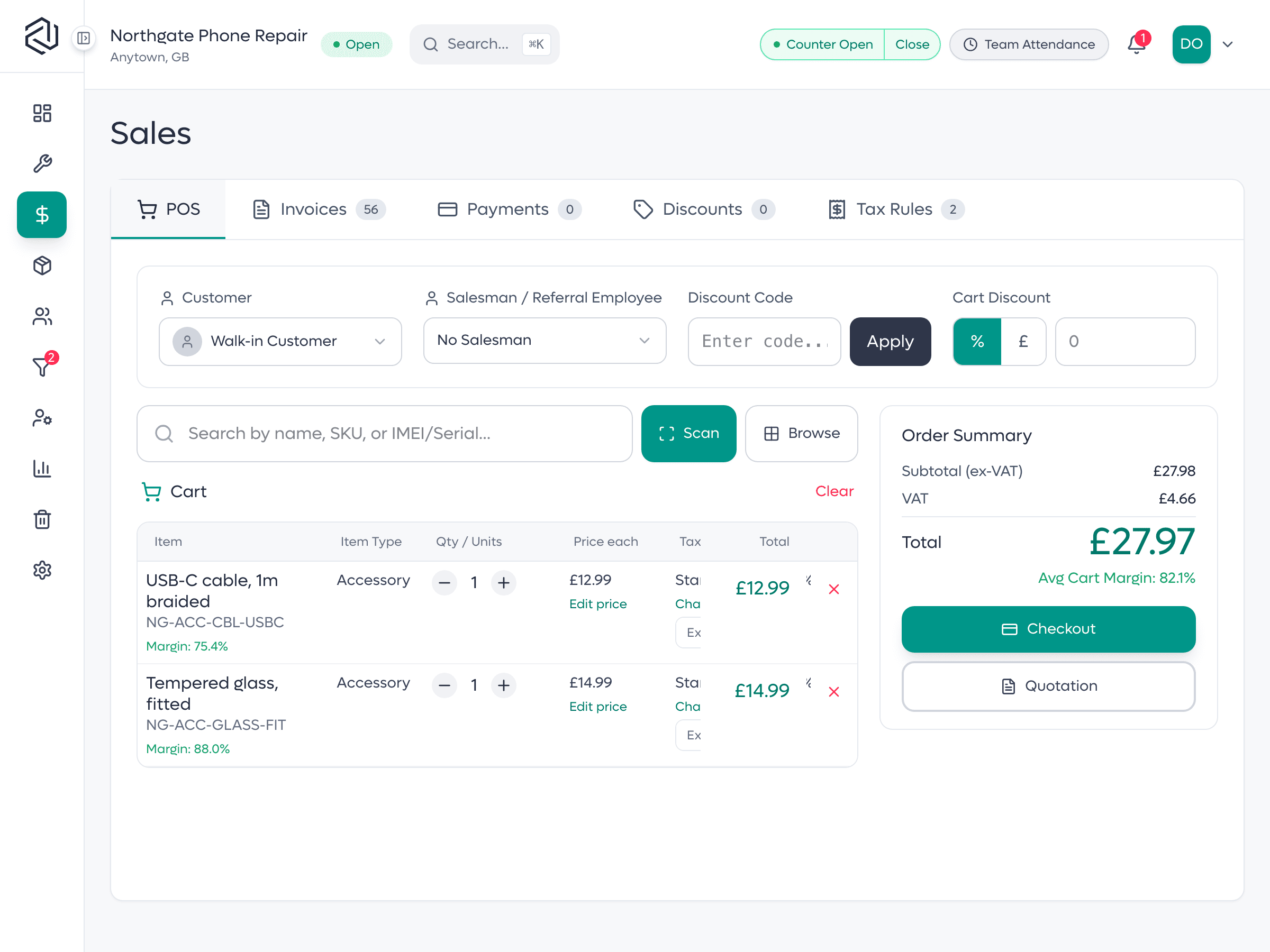
One search box for name, SKU or serial
The till searches products by name or SKU and stock units by serial from the same box. A refurbished console comes up as its own unit, and only a unit still in stock can go on the sale.

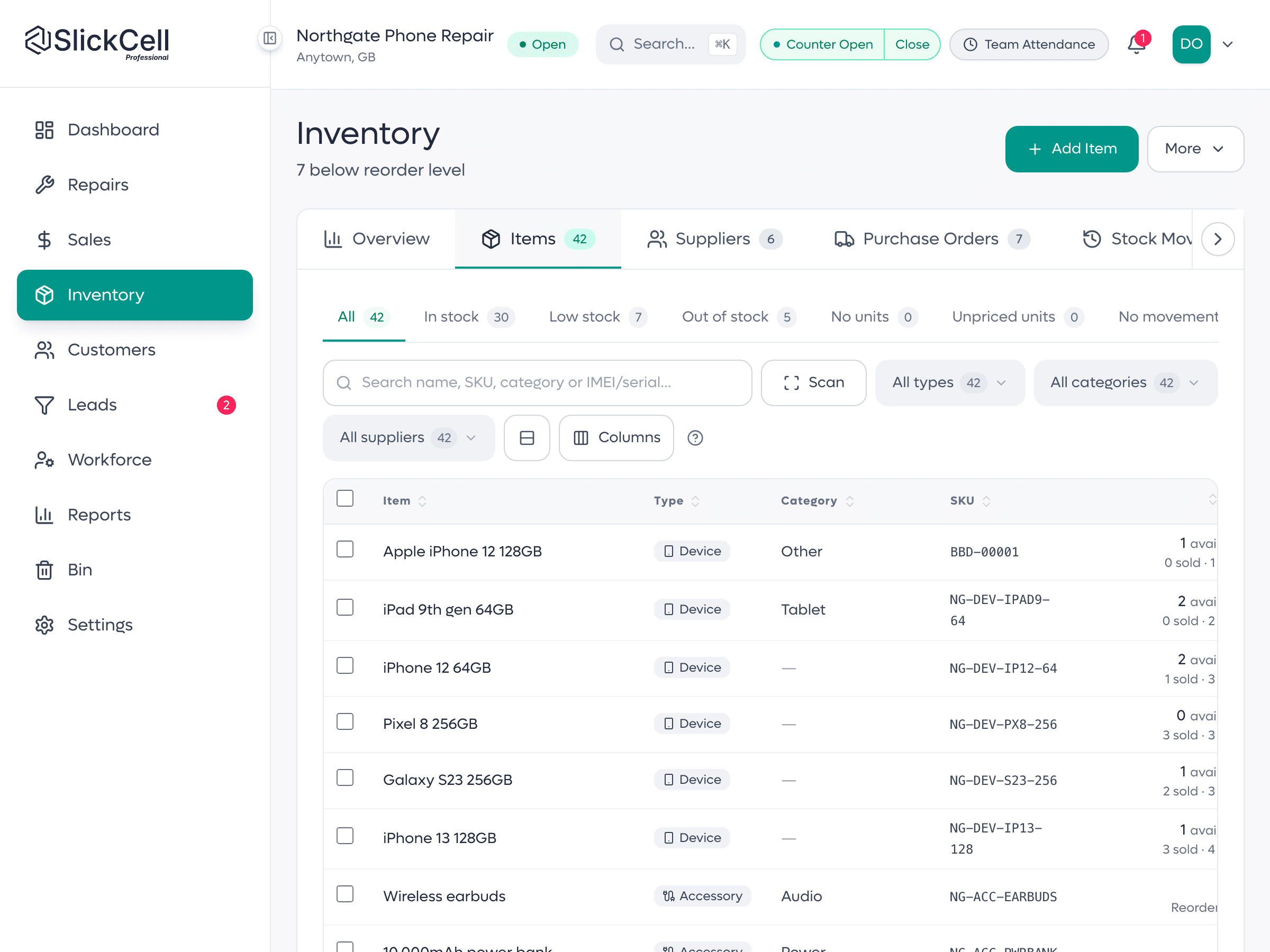
Stock by category, units by serial
Parts and accessories are counted by quantity; devices are counted from their units. A console you add defaults to the category Consoles, so the list filters consoles on their own, and the search box finds a unit by its serial.
What changes
What a console shop owner notices after the first month.
- Serials that match at collection
- The console is booked in by its serial, so the one handed back is the one that came in.
- Refurbished consoles costed per unit
- A console you rebuild to sell carries its own cost and price, so its margin is real.
- Trade-ins become stock at their cost
- A console bought over the counter enters stock at the price paid plus any refurbishment.
- Who is on which console
- The repairs queue shows the technician on every job and filters by technician.
Built for the bench and the counter
Repairs
One ticket per job, from booked in to collected, with the quote on it.
Awaiting parts
A real status with a date, so a job waiting on a drive is never forgotten.
Consoles by serial
A serial with letters is saved as a serial and shown on the ticket as S/N.
Handhelds too
Steam Deck, ROG Ally, Legion Go, MSI Claw and retro handhelds are in the console list.
Trade-ins
Inspect, pay by cash, transfer or credit, and the console enters stock at its cost.
Parts by quantity
Fans, drives, ports and paste counted; consoles tracked one by one.
A till for the counter
Repairs, accessories and refurbished consoles on one sale.
Deposits and balances
Money taken at booking counts against the bill at collection.
Customer updates
Email the customer from the job; the QR on the receipt opens live tracking.
Stocktake
Count against a snapshot; stock moves only once approved.
Find a unit by serial
Type or scan a serial in stock or at the till to find that one console.
More than one branch
One login across shops, with stock and staff kept per branch.
What console shop owners ask
The questions shops ask before they switch, answered straight.
Exactly as it is printed on the console. At booking, one field takes the serial number or the IMEI, and a serial with letters in it is saved as a serial number and shown on the ticket as S/N. In stock, each unit's reference is free text labelled IMEI / Serial, with no format check, so a console serial goes in as printed.
Yes. Every device is its own record with its own IMEI or serial number, cost, condition, selling price and history. A phone is usually tracked by IMEI; a laptop, console, tablet or smartwatch by its serial number. Both are free text, so a partial or unusual reference from older stock is accepted.
Yes. Games Console is one of SlickCell's device types, beside phones, tablets, smartwatches, laptops, desktops and all-in-ones, and earbuds and headphones. Each type has its own brands, models and specification fields, and one ticket, one till and one stock list cover them all.
Yes. A trade-in is a buyback record with the console's type, brand, model, serial, edition and controllers, an inspection and a payment in cash, by bank transfer or as trade-in credit. Added to inventory, it becomes a stock unit at what it cost you, ready to sell at the till.
Starter is £39 a month, Professional £59 and Supplier Pro £99, all excluding VAT, or ten times the monthly price for a year. Every feature is on every plan; plans differ by team size, locations, discount rules and support. Every plan starts with a fourteen-day free trial with no card.
No. Sign up with your name, email address and a password and the fourteen-day trial starts straight away, with every feature included and no card.
Bring us a console job
A console booked in by serial, repaired, refurbished and sold, or bought over the counter. We will run it end to end on your own workflow.