

How to start a phone repair business in the UK
How to start a phone repair business in the UK: what to repair, where to trade, Companies House and HMRC, parts, pricing and first customers.
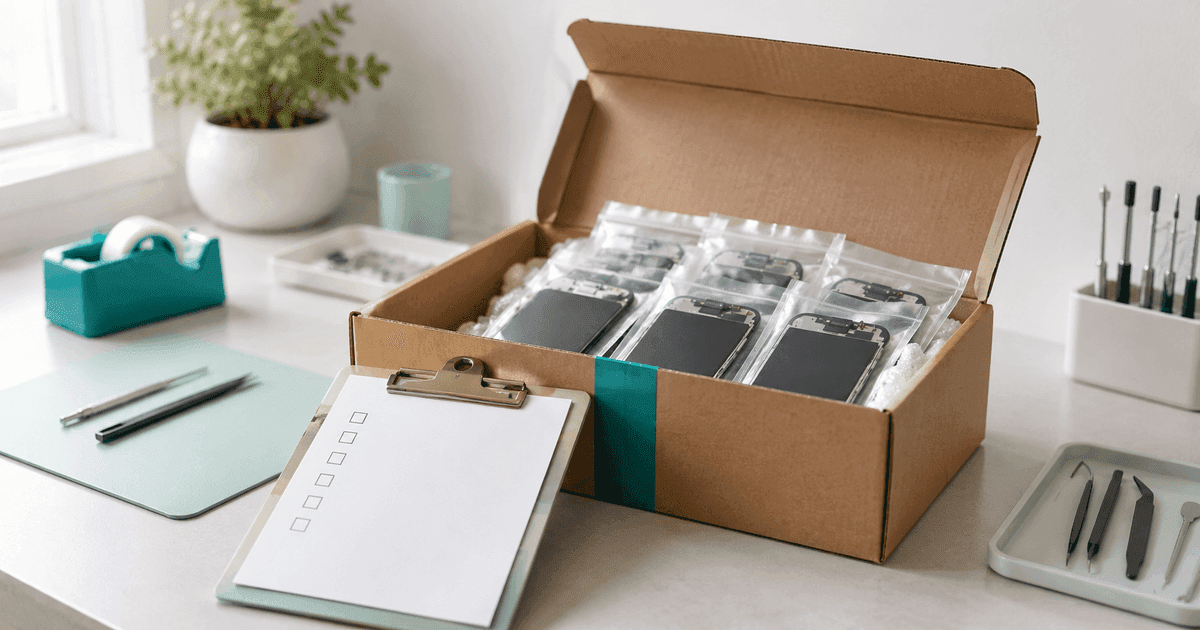
Starting a phone repair business in the UK takes less money than opening most shops, and more decisions than most people expect. This guide on how to start a phone repair business takes them in the order they arrive: what you will repair, where you will do it, how to set the business up, where parts come from, how to price a repair, how to find your first customers and how to keep track of every device that comes through the door.
Each legal step links to the GOV.UK page that explains it, because that is the source that counts, and none of this is legal or tax advice. It is written by SlickCell, which makes repair shop software, so the software section near the end is ours; everything before it applies whatever you use. If you also repair tablets, laptops or games consoles, almost all of it still applies. (In the US the same question is usually asked as how to open a cell phone repair store; the business steps below are the UK ones.)
Decide what you will repair
Phones only, or phones plus tablets, laptops, consoles and smartwatches? The answer sets almost everything that follows: the tools on your bench, the parts you stock, the skills you need and who walks through the door.
Most people start narrow. Screens, batteries and charging ports on the phones you see most often are the bulk of counter work, and they are the repairs you can learn, stock and price with confidence. Board-level work, water damage and data recovery are separate skills; add them when you have the time to learn them properly, or send those jobs to a specialist and keep the customer.
Widening later is easier than narrowing. A shop that says it fixes everything and then turns jobs away loses more trust than one that says exactly what it does.
Home, market stall, kiosk or shop
Each has a different trade-off between cost, footfall and trust.
- From home. The cheapest start, and the one where customers have to trust you most, because they are handing over a device full of their life to a front door. Think about where customers' devices are kept overnight.
- A market stall or kiosk. Footfall without a full shop's rent, but little bench space and nowhere secure to leave work in progress.
- A shop. The most trust and the most cost: rent, rates, a counter, a secure place for devices and room to grow into selling accessories and used phones.
If you plan to work from home, GOV.UK says you may need permission from your mortgage provider or landlord, or from your local council if you will have lots of customers or want to advertise outside, and that home insurance may not cover your business, including stock and customers visiting (official guidance). You may also have to pay business rates on the part of your home you use for the business (official guidance).
Set up the business
Most businesses register as a sole trader or a limited company, and the structure you choose affects how you pay tax and your legal responsibilities (official guidance).
Sole trader. The simplest structure to set up and keep records for. You can start trading straight away, but you must register for Self Assessment if you earn more than £1,000 in a tax year, and you are personally responsible for all of the business's debts (official guidance). You can trade under your own name or a trading name.
Limited company. A company is legally separate from the people who own it, and you register it with Companies House before you start trading. Directors must keep company and accounting records and file accounts and tax returns, and the company pays Corporation Tax on its profits (official guidance). There are rules to follow when choosing a company name.
GOV.UK notes it is usually easier to move from sole trader to limited company than the other way (official guidance), so many repair shops start as sole traders and incorporate later. An accountant can tell you which suits your numbers.
VAT: when you have to register
You must register for VAT if your total taxable turnover for the last 12 months goes over £90,000, or you expect it to go over £90,000 in the next 30 days. You can choose to register below that (official guidance).
If you will buy used phones from the public and sell them on, read about the VAT margin scheme before your first sale: it decides whether you pay VAT on the whole selling price or only on your margin. The margin calculator shows the difference on your own figures.
Customer data and devices
A repair shop holds names, phone numbers and email addresses, and the devices themselves are full of personal data. GOV.UK says you must follow the data protection rules if your business stores or uses personal information, keep it secure, accurate and up to date, and tell the Information Commissioner's Office (ICO) how your business uses personal information (official guidance). Most businesses that process personal data pay the ICO a data protection fee, which for most small businesses is £52 or £78 a year, unless they are exempt (official guidance).
Insurance is a question to ask an insurer, not a box GOV.UK ticks for you: public liability, and cover for customers' devices while they are in your care, are both worth asking about before the first device is left with you.
Old parts and batteries
Dead screens, swapped-out batteries and broken boards pile up faster than you expect. Waste from a business is business waste, and you must store it safely, use a registered waste carrier and complete a waste transfer note for each load that leaves your premises; there are extra responsibilities for hazardous waste (official guidance). Read that page before the first box fills up.
If you sell new electrical items, such as chargers, headphones or phones, you must also give customers a free way to dispose of their old household electrical equipment when they buy a new version of the same item (official guidance).
Tools and a bench
What you need to start, before any parts:
- precision screwdrivers for the fastenings on the devices you repair;
- spudgers, opening picks and suction cups;
- a heat mat or heat gun, and a screen separator if you do glass or screen work;
- an anti-static mat and wrist strap;
- magnification: a lamp, a loupe or a microscope as your work gets finer;
- a bench power supply for testing;
- a parts organiser, so a screw from one phone never ends up in another.
Buy for the repairs you decided to do first, not for every repair there is.
Where UK repair shops buy parts
Most shops buy from trade parts suppliers and wholesalers. Before you order, ask each one for a trade account, how returns work on faulty parts, and how they grade screens, because two screens for the same phone can differ a great deal in quality and price. Order small at first, test what arrives, and keep the suppliers whose faulty-part returns are straightforward.
How to price a repair
A repair price covers three things: the part, your time, and an allowance for the parts that fail or come back. Work out each one per repair type:
- what the part costs you, delivered;
- how long the job takes you, honestly, at the hourly rate you need to earn;
- a margin for comebacks and the occasional part that fails on the bench.
Then quote before you start work, and write down what the customer agreed. A quote that is written down and approved is the difference between a repair and an argument at collection.
Is a phone repair business profitable?
It can be, and the only way to know whether yours is, is to measure it. Profit is set by four things: what parts cost you, how long each job takes, how often work comes back, and what the premises cost. For the first three months, record each job's parts cost against its price, and how many jobs come back. By the end of the quarter you will know which repairs pay and which only keep you busy.
Your first customers
- Google Business Profile. Set it up with your opening hours and the repairs you do; it is where local searches land.
- A sign that says what you fix. "Phone and tablet repairs, screens and batteries while you wait" says more than a logo.
- Local groups and noticeboards. Answer questions where people ask them.
- Other shops. A phone shop that does not repair may send you its repairs.
Ask happy customers for a review, honestly, and never in exchange for anything.
Keep a record of every device from day one
From the first repair, keep one record per job: the device with its IMEI or serial number, the fault, its condition when it came in, the quote, any deposit and what was paid. Keep stock the same way, one record per device you buy to sell, with its own cost, and it is ready when the VAT margin scheme needs it.
One phone is one unit with its own IMEI or serial, cost, condition, battery health, selling price, supplier and history. Quantity is counted from the units, never typed, so you see the exact profit on the exact phone you sold. A deposit is taken against the job, parts are committed from stock, extra work is quoted before the price changes, a part payment leaves a real balance, and a paid invoice is locked. The ticket, the till, the invoice and the report all agree. Second-hand stock can be taxed on the margin between what you paid for that unit and what you sold it for, reported separately from standard-rated sales. Because every device carries its own purchase cost, the per-item record the margin scheme asks for is already there.SlickCell does this in one system from £39 a month, with a 14-day trial you start yourself and no card. If you are comparing options, see what free repair shop software really costs, the best repair shop software in the UK compared, or SlickCell pricing.
Questions people ask before they start
Can I start a phone repair business from home?
Yes, many do. GOV.UK says you may need permission from your mortgage provider or landlord, or your local council in some cases, and that home insurance may not cover your business (official guidance). Check those, and decide where customers' devices will be kept overnight.
Do I need to register for VAT?
Only once your taxable turnover for the last 12 months goes over £90,000, or you expect it to in the next 30 days; you can choose to register below that (official guidance). If you sell used phones, the VAT margin scheme changes what you owe on them.
What tools do I need to start?
Precision screwdrivers, spudgers and opening picks, a heat mat or heat gun, an anti-static mat and strap, magnification, a bench power supply and a parts organiser, bought for the repairs you plan to do first.
What software do phone repair shops use?
Most run repair shop software that holds the repair ticket, the till and the stock together, with devices tracked by IMEI or serial. See the best repair shop software in the UK compared.
General information, not legal or tax advice. Check the published guidance or speak to an accountant. Figures and rules on this page (the £1,000 Self Assessment limit, the £90,000 VAT threshold and the ICO fee) were checked against GOV.UK on 25 September 2026.